


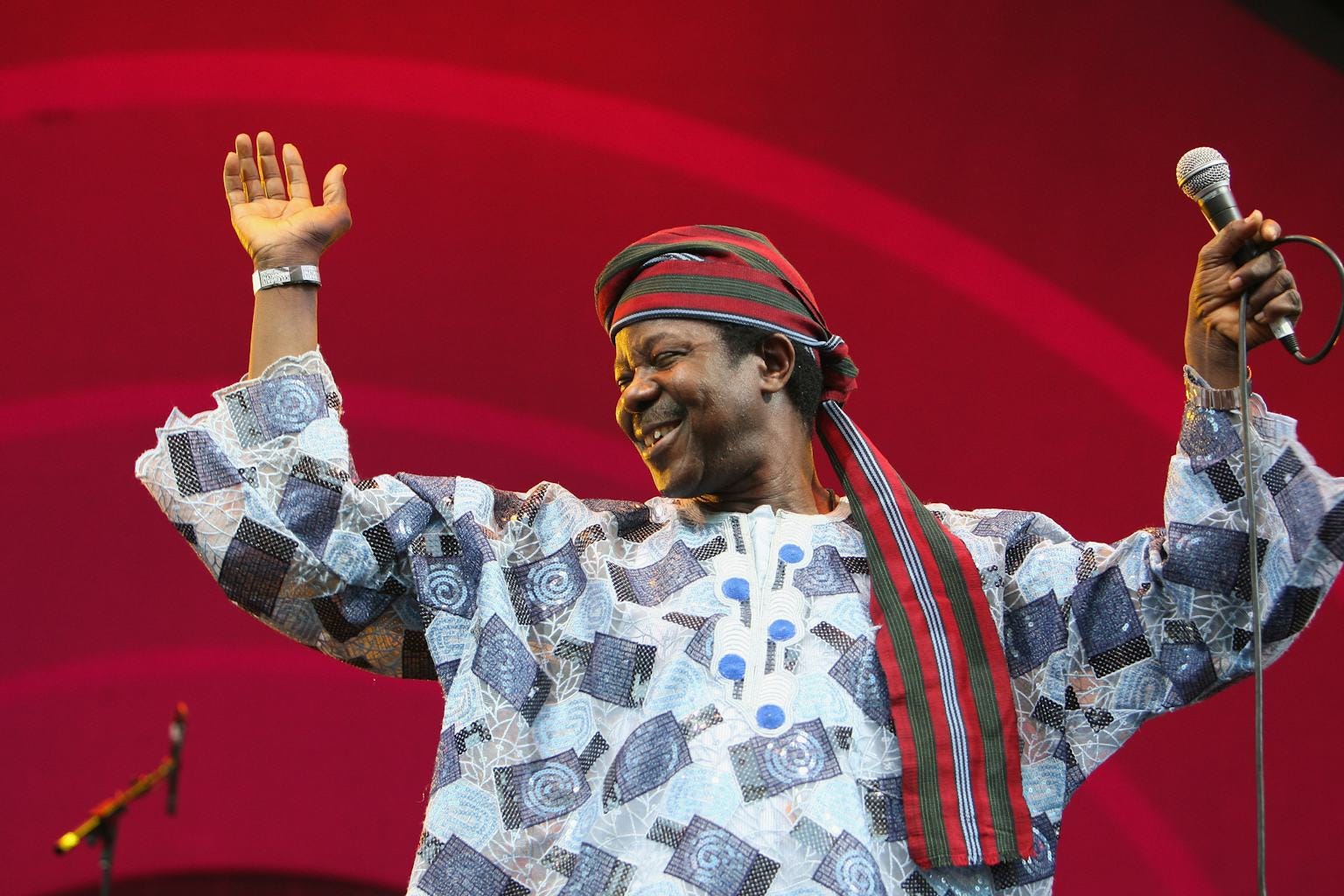
King Sunny Ade at 80: Eight Decades of Rhythm, Legacy and Global Stardom
By Matthew Eloyi
At 80, Sunday Adegeye, popularly known as King Sunny Ade (KSA), is being celebrated not merely as a veteran musician, but as one of the towering figures who helped take Nigerian music from local stages to the international arena.
As the legendary jùjú music maestro marked his 80th birthday on Tuesday, social media platforms became a virtual celebration ground, with fans, admirers and fellow musicians flooding the internet with messages praising his enduring career and immense contribution to Nigerian music.
For many of his admirers, KSA represents a generation of musicians whose music transcended entertainment to become part of Nigeria’s cultural identity.
From his early days playing with Moses Olaiya’s Federal Rhythm Dandies to his emergence as leader of the Green Spots in 1967, and later African Beats, King Sunny Ade spent more than six decades refining a distinctive musical sound that blended Yoruba traditions with modern instruments and contemporary performance.
His music brought together talking drums, guitars, percussion, call-and-response patterns and traditional praise singing, helping jùjú music evolve into a sophisticated form that could appeal to audiences far beyond its Nigerian roots.
From Ondo to the world
Born on September 22, 1946, in Ondo State, Adegeye began his musical career at a time when Nigeria’s popular music scene was undergoing significant transformation.
His association with Moses Olaiya’s Federal Rhythm Dandies provided an important foundation for the young musician. But it was the formation of the Green Spots in 1967 that marked the beginning of a journey that would eventually establish him as one of the leading figures in African music.
The group later became known as African Beats, while Ade continued to develop the sound and stagecraft that would make him internationally recognised.
By the 1980s, his music had crossed Nigeria’s borders and attracted the attention of international audiences. His signing with Island Records brought him onto the global music scene, with albums such as Juju Music and Synchro System introducing his distinctive sound to listeners around the world.
His international breakthrough also demonstrated that African traditional musical forms could compete for space on the global stage without losing their cultural identity.
The Grammy milestone
One of the defining moments of KSA’s international career came with his acclaimed album Synchro System.
The album earned him a Grammy nomination in the Ethnic/Traditional Folk Recording category, making him the first Nigerian Grammy nominee.
His 1998 album Odu later received another Grammy nomination in the Best World Music Album category.
Although the Grammy nominations were international recognition of his work, KSA’s influence went beyond awards. His career helped create a bridge between Nigeria’s indigenous musical traditions and the international music industry.
A legend built beyond records
KSA’s contribution to music has also been reflected in the numerous honours he has received over the years.
In December 2016, he was inducted into the Hard Rock Café Hall of Fame, followed by his induction into the Headies Hall of Fame in February 2021.
He is also a recipient of the Member of the Order of the Federal Republic (MFR), a national honour recognising his contribution to the Nigerian music industry.
Yet, perhaps more significant than the awards is the longevity of his career.
For more than six decades, King Sunny Ade has remained a recognisable name in Nigerian music, surviving dramatic changes in musical taste, technology, distribution and audience behaviour.
A social media celebration
His 80th birthday brought that enduring popularity into sharp focus.
Following a birthday message posted by Nigerian digital news and storytelling platform @NigeriaStories on its verified X account, fans and admirers responded with tributes celebrating the musician’s longevity and influence.
One admirer, @Gods Son, recalled growing up listening to KSA’s music in his village and described him as a true legend.
Another fan, @richard Oluwagbem, noted that he was born in the same month as the music icon, while @fshion peel simply marvelled at the musician’s longevity.
Others prayed for continued good health and long life.
“Happy birthday to a legend not just in Juju music but in music generally,” wrote @dvmmytex.
@olowookere described him as a favourite legend whose 80 years represented “greatness and an unforgettable contribution to Nigerian music.”
Another admirer, @foxyy, highlighted what he regarded as one of KSA’s greatest achievements — not merely his international recognition, but his ability to build a durable music business and performance infrastructure around his career.
The comments reflected something larger than birthday celebration: the continuing emotional connection between KSA and generations of listeners.
A legacy that outlives generations
KSA’s career is particularly significant because he belongs to a generation of Nigerian musicians who demonstrated that indigenous musical traditions could become commercially successful without being stripped of their cultural identity.
His jùjú music carried the rhythms, language, instruments and storytelling traditions of the Yoruba people while incorporating guitars, modern production techniques and international performance styles.
That ability to blend tradition and modernity became central to his appeal.
At 80, therefore, King Sunny Ade’s story is not simply one of longevity. It is also a story about the evolution of Nigerian music itself — from local dance halls and live bands to international record labels, global tours, digital platforms and a music industry that now commands worldwide attention.
Fellow music veteran Ebenezer Obey-Fabiyi, who has shared a decades-long relationship with KSA, was among those who celebrated the octogenarian’s musical journey.
As tributes continue to pour in, King Sunny Ade stands as a living link between generations of Nigerian music — a musician whose career helped preserve indigenous sounds while opening doors to global audiences.
At 80, the King of jùjú music is still being celebrated for the sound that made him famous, the cultural heritage he carried with it, and a musical legacy that has endured for more than six decades.
