


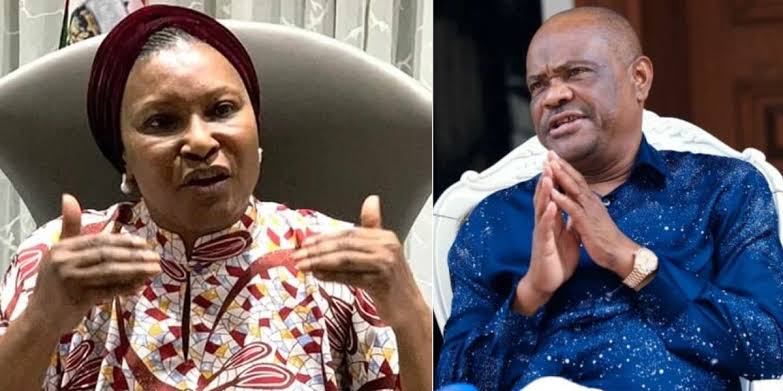
Wike, Kingibe and the Battle Over Who Pays for Abuja’s Transformation
By Matthew Eloyi
The growing political disagreement between Minister of the Federal Capital Territory, Nyesom Wike, and Senator Ireti Kingibe has taken a new turn, with the financing of Abuja’s rapidly expanding infrastructure projects becoming the latest battleground.
Kingibe had questioned whether the FCT administration obtained loans to finance capital projects in the nation’s capital without the statutory approval of the National Assembly.
But Wike, who spoke in Abuja on Tuesday after inspecting some ongoing projects, dismissed the allegation, insisting that government borrowing cannot simply be undertaken outside the established budgetary and legislative framework.
For the minister, the issue is not merely about whether Abuja is witnessing an unprecedented wave of construction, but about how such projects are financed and whether the financing process complies with established public finance procedures.
“If you want to take a loan, you will include it in the budget. It is part of the budget that we are going to collect a loan to execute some projects in the FCT,” Wike said.
His response was also couched in sharp political language, as he questioned Kingibe’s understanding of legislative and public finance procedures.
The exchange illustrates the increasingly adversarial relationship between two prominent political figures whose interests intersect around the administration and political representation of the Federal Capital Territory.
The financing question
At the heart of the controversy is a fundamental question in public finance: how does a government secure financing for major capital projects, and what role does the legislature play in authorising such borrowing?
Wike’s position is that borrowing for public projects must be reflected in the budget and subjected to the required legislative process. He therefore rejected the suggestion that the FCT administration could independently secure a loan without the involvement of the National Assembly.
The minister argued that the scale of infrastructure development currently visible across Abuja should not automatically be interpreted as evidence that the administration had secretly borrowed money.
“Assuming I took a loan, our concern should have been: are we applying the loan to fulfill the interest of residents?” he asked.
That argument shifts the debate from the mere existence of financing to the purpose and application of public funds.
The FCT administration has embarked on numerous road, transportation and other infrastructure projects, creating a highly visible transformation of parts of the capital. For Wike, the physical evidence of construction is proof that the administration is delivering on its responsibilities.
READ ALSO: King Sunny Ade at 80: Eight Decades of Rhythm, Legacy and Global Stardom
For his critics, however, the scale of spending inevitably raises questions about the source of funds, the approval process and the long-term financial implications.
It is this gap between infrastructure delivery and financial accountability that has placed the financing question at the centre of the latest political dispute.
Infrastructure as political capital
Abuja’s roads and other major projects have increasingly become a defining feature of Wike’s administration.
The minister has repeatedly presented infrastructure development as a key measure of his stewardship of the FCT. Consequently, criticism of the projects or questions about their financing are likely to be interpreted within the broader political contest over the performance of his administration.
Wike suggested that Kingibe’s position had changed as the projects began to take shape.
“I thought she criticised that I’m doing nothing. So now her problem is that I took a loan,” he said.
The comment captures a broader political argument: whether the administration should primarily be judged by the visible infrastructure it delivers or by the processes through which it finances and executes those projects.
For citizens, the two questions are not necessarily mutually exclusive.
Infrastructure may address pressing urban needs, but major public expenditure also raises legitimate questions about budgeting, procurement, borrowing, accountability and sustainability.
From policy disagreement to political confrontation
The dispute has also moved beyond technical questions of public finance into the politics of representation in the FCT.
Wike dismissed Kingibe’s political relevance, asserting that her tenure in the Senate was effectively coming to an end.
He further claimed that residents of the territory had already chosen to support President Bola Tinubu and Philip Aduda, who represented the FCT in the 7th, 8th and 9th Senates.
“She’s already packing her things out. The people have made a choice; they are going to support President Tinubu and Aduda,” Wike said.
The statement transformed what began as an argument over public financing into a wider contest over political legitimacy and influence in Abuja.
Kingibe’s criticism, on the other hand, places her in the role of a legislator questioning the actions of the executive and demanding explanations about the management of public resources.
The clash therefore reflects two different dimensions of public office: the executive’s emphasis on implementation and delivery, and the legislature’s oversight responsibility.
The bigger issue for Abuja
Beyond the personalities involved, the disagreement raises an important question about how the FCT should balance rapid development with transparency and institutional oversight.
Abuja is experiencing significant pressure from population growth, expanding settlements, traffic congestion and increasing demand for roads, public transportation and other urban infrastructure.
Meeting those needs requires substantial investment. But the larger the projects and the greater the public expenditure, the more important clear financing arrangements and institutional accountability become.
Wike’s response suggests that his administration regards the current infrastructure programme as evidence of progress rather than evidence of financial impropriety.
Kingibe’s allegations, as reported, point instead to concerns about the legality and approval process surrounding possible borrowing.
The resolution of that disagreement ultimately rests not on political exchanges but on documentary evidence: budgets, appropriation records, financing agreements, approvals and expenditure records.
Those documents, rather than political assertions from either side, would provide the clearest basis for determining how major FCT projects are being financed.
For now, however, the disagreement has become another chapter in the increasingly intense political contest surrounding Abuja, a contest in which roads, bridges and other infrastructure have become not only symbols of development but also instruments in a larger debate over power, accountability and political influence.
And as construction continues across the nation’s capital, the question of who pays for Abuja’s transformation, and under what authority, is likely to remain as important as the projects themselves.
