

OSUN ELECTION 2027: GOVERNOR ADELEKE DANCED ON APC’S GRAVE AGAIN
By Jerry Adesewo, Abuja
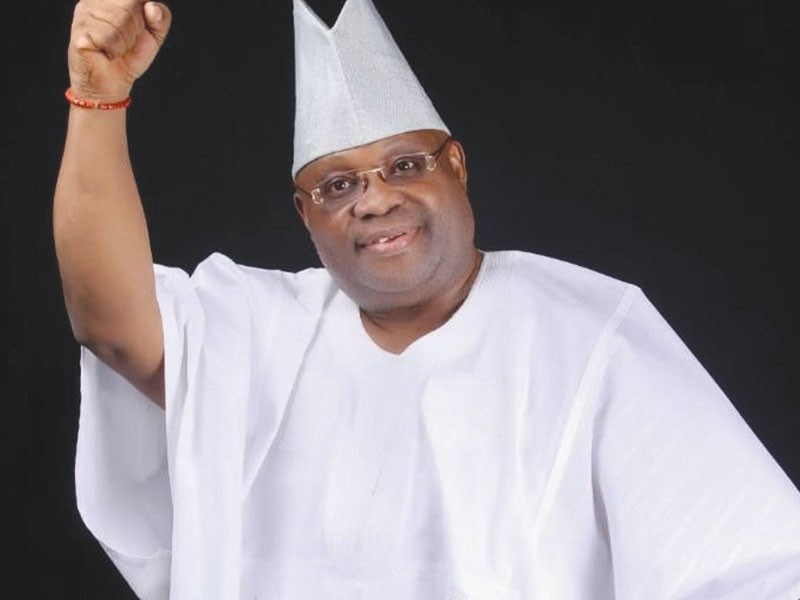
Some elections are won at the polling booths, and there are elections whose real story begins long before voters thumb their ballots. The 2026 Osun governorship election belongs to the latter category. By the time the Independent National Electoral Commission declared Governor Ademola Adeleke of the Accord Party winner in the early hours of Sunday, defeating the All Progressives Congress candidate, Bola Oyebamiji, with 511,067 votes, the election had already travelled through a remarkable maze of defections, political manoeuvres, institutional controversies, violence, security deployments, and accusations of federal interference.
And yet, after all the noise, it was Adeleke who emerged standing
READ ALSO: Adeleke Declared Winner of Osun Governorship Election
Perhaps that is why the title of Barclays Ayakoroma’s play, Dance on His Grave, keeps coming to mind. Ayakoroma’s play is a political work dealing with power, rebellion, and the consequences of political authority. In Osun, there was no literal grave, of course, but politically speaking, Adeleke danced on the grave of an APC campaign that appeared increasingly determined to reclaim the state at almost any cost.
The irony is that the APC did not enter the election as an insignificant challenger. It had the federal government behind it politically, a formidable party structure, experienced politicians, and a candidate, Bola Oyebamiji, who had served as Managing Director of the National Inland Waterways Authority. For much of the campaign, the contest was presented as a serious two-horse race between Oyebamiji and Adeleke.
But somewhere along the road, the APC’s campaign encountered a problem that no amount of political machinery could easily solve: Adeleke had become more than a candidate. He had become a political brand in Osun.
That is perhaps the most important lesson from this election.
Adeleke’s first victory in 2022 was initially dismissed by many as a combination of political circumstances, family influence, celebrity appeal and APC internal divisions. Four years later, that explanation has become considerably harder to sustain. His re-election suggests that whatever political capital he accumulated in 2022 was not exhausted by his first term.
Indeed, throughout the months preceding the election, there were repeated claims of strong grassroots support for the governor. A Geopolitics Survey International poll reported significant support for Adeleke, although the figures and methodology were contested in the political debate. The governor’s opponents dismissed some of the polling claims, while his supporters presented them as evidence of public approval.
But perhaps the more convincing evidence was not found in the polls. It was found in the political behaviour of people and groups that had little reason to support an incumbent unless they believed he could win—or unless they believed he had actually delivered something worth defending.
Cooperative groups endorsed him. Traditional security and community organisations endorsed him. Ethnic associations joined the mobilisation. A former Labour Party candidate mobilised more than 1,000 people in support of his re-election.
Then came the extraordinary final twist.
Two opposition candidates—Adedamola Adebayo of the PDP and Adebayo Simon Adewale of the APM—stepped down shortly before the election and endorsed Adeleke. The PDP candidate’s decision was particularly significant because it effectively removed a party that had historically been Adeleke’s political home from the ballot while its candidate asked his supporters to back the incumbent.
That was not merely an electoral calculation. It was a political statement.
The argument advanced by those who stepped down was that the election had become bigger than individual ambition. They presented their decision as an attempt to prevent the return of the APC and to protect what they considered the broader interests of Osun.
It is impossible to ignore the irony. Adeleke had left the PDP because of the party’s internal crisis and joined Accord. Yet, on the eve of the election, the PDP structure in Osun had already endorsed his re-election, directing its members across the state to support him under Accord. In other words, the man who had technically left the PDP did not necessarily leave its political soul behind.
But this election was not without its dark side The road to August 15 was deeply troubling.
The Centre for Journalism Innovation and Development’s Conflict Tracker recorded at least 34 election-related violent incidents and 18 deaths in Osun between May and the election. Other political actors alleged even higher casualties. There were clashes, attacks, accusations of political thuggery, and a growing atmosphere of fear.
At one point, a resident of Esa-Oke was killed and another person injured in political violence. The Accord Party also alleged that at least 15 of its members had been killed in attacks it attributed to APC-linked thugs, an allegation that should be treated as an allegation rather than established fact.
Then came the security question. The Nigeria Police Force deployed 15,000 personnel, while the Nigeria Security and Civil Defence Corps deployed another 10,000 officers drawn from 10 state commands. That is an extraordinary security footprint for a state governorship election. And one must ask: What kind of democracy requires 25,000 security personnel simply to reassure citizens that they are safe enough to vote?
The replacement of the Osun Commissioner of Police further deepened the controversy. The police said the change was intended to prevent disputes over the command from undermining confidence in the election, following mounting complaints about the neutrality of the outgoing commissioner.
Then, barely ten days before the election, the EFCC restricted an Osun State Government account amid an investigation into alleged financial misconduct involving about ₦11 billion. The Adeleke administration called the action politically motivated; the EFCC said it was acting to protect public funds.
The timing was explosive.
President Bola Tinubu eventually ordered the EFCC to vacate the restriction, saying he was embarrassed by the timing and that nothing should be done to create the impression that federal agencies were being used to interfere with the election.
Whatever one’s political affiliation, that episode was damaging to public confidence. An anti-corruption investigation may be legitimate. A state government’s finances may legitimately be investigated. But when such an action occurs immediately before an election involving the President’s party and an incumbent governor who is his political opponent, the optics are inevitably problematic.
Democracy is not only about doing the right thing. It is also about doing the right thing at the right time and in a manner that preserves public confidence.
So why did Adeleke survive the storm? The answer, in my view, lies partly in the simple politics of performance and identification.
Adeleke has successfully cultivated an image that is unusually personal for Nigerian politics. His dancing, informality, and accessibility may have initially made him appear unserious to sections of the political elite. But those same qualities have helped him connect with ordinary people.
More importantly, his administration has placed considerable emphasis on visible projects, including roads, healthcare, education, workers’ welfare, and grassroots interventions. His supporters point to these as evidence that his administration has delivered tangible benefits. Even some political endorsements came explicitly on the basis of perceived performance.
There are, of course, critics who see the administration very differently. One recent assessment published by The Nation, for example, described Adeleke’s administration as an emblem of decline and accused it of underperformance. That criticism is important because no serious assessment of a government should rely solely on the governor’s supporters.
But elections are not academic examinations marked by commentators. They are referendums conducted by voters. And Osun voters have now given their verdict.
Adeleke secured 511,067 votes, while Oyebamiji polled 444,815, giving the incumbent a margin of 66,252 votes. Adeleke also won 19 of the state’s 30 local government areas, while Oyebamiji won 11.
That is not a landslide. But it is decisive. Adeleke did not win because the APC was absent. He won while the APC was fully present and aggressively campaigning. He did not win because there were no allegations of violence or political interference. He won despite an election environment saturated with them. He did not win because opposition parties were united against the APC from the beginning. He won after a series of extraordinary political realignments eventually consolidated significant opposition sentiment around his candidacy.
The APC wanted Osun badly. The federal political machinery was clearly interested in the outcome. But Osun voters had the final say.
The grave that matters
This is where Ayakoroma’s Dance on His Grave becomes an interesting metaphor. Political graves are rarely dug by one person. They are dug by accumulated mistakes, arrogance, internal contradictions, misreading of public sentiment, and the failure to understand what voters are saying.
The APC may have believed that federal influence, party structure, and opposition to Adeleke’s administration would be enough to return it to the Osun Government House. It was not. Perhaps the party misunderstood the difference between political power and political acceptance.
A government can control institutions. A party can control structures. Politicians can command resources. But none of these automatically translates into the affection of the electorate.
Adeleke’s greatest victory, therefore, may not be that he defeated Oyebamiji. It may be that after four years in office, the electorate had the opportunity to remove him and instead chose to give him another four years.
That is the real referendum.
For all the shenanigans that preceded the election, Osun voters ultimately demonstrated something Nigerian politicians frequently forget: people may complain about a government and still prefer it to the alternative.
And so, as the dust settles over Osogbo, the music is playing again. The governor who once danced his way into the political imagination of Osun has danced his way back into the Bola Ige House.
This time, however, the dance is not merely entertainment. It is an electoral statement. Adeleke danced on the APC’s grave again.
The question now is what he does with the victory. Because the people have given him another four years—not merely to dance, but to govern.