

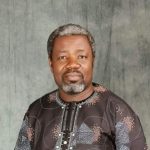
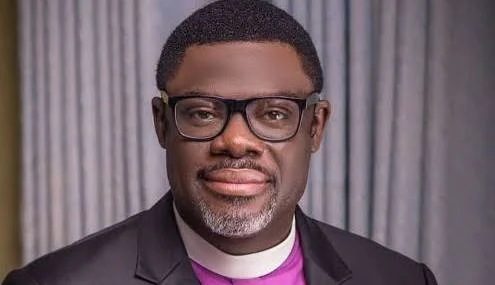
Prophet Isa El-Buba: When the Prophet Is Angry
By Jerry Adesewo
There is something unsettling about watching a prophet become angry.
We are accustomed to seeing prophets pray, preach, bless, encourage, and comfort. We expect the man of God to speak softly about love, forgiveness, and reconciliation. We expect the pulpit to be a sanctuary from the noise and bitterness of politics. But there are moments when a prophet’s anger becomes part of his message, particularly when what he sees around him threatens the values he believes he has been called to defend.
READ ALSO: Nigerian Army Troops Neutralise Two Terrorists, Recover AK-103 Rifles in Zamfara
That is what makes Prophet Isa El-Buba’s latest intervention in the controversy surrounding Islamic cleric Sheikh Yahaya Jingir worth examining beyond the immediate political argument.
El-Buba has condemned Jingir over comments concerning the Muslim-Muslim political ticket and what he considers derogatory remarks about Christians. The confrontation is significant not merely because one cleric has criticised another, but because it places two religious voices on opposite sides of a question that has continued to expose some of Nigeria’s deepest anxieties about religion, politics, and national identity.
El-Buba is not a stranger to speaking controversially on the subject. In 2022, when the All Progressives Congress presented Bola Ahmed Tinubu and Kashim Shettima on a Muslim-Muslim ticket, he described the decision as injurious to Christian sensibilities and argued that Nigeria had not yet reached the level of trust required for a single-faith presidential ticket.
One may disagree with some of El-Buba’s political conclusions. One may also question whether religious leaders should become so deeply involved in electoral politics. But it is difficult to dismiss the larger question his interventions raise: What responsibility do religious leaders have when religion is used as an instrument of political mobilisation?
That question is bigger than El-Buba and Jingir.
Nigeria is a deeply religious country. Christianity and Islam shape the worldview, identity, and daily lives of millions of Nigerians. That influence can be a force for compassion, social responsibility, and national cohesion. But precisely because religion commands such enormous emotional and moral authority, religious leaders carry a special responsibility to ensure that their words do not become fuel for division.
This is where prophetic anger becomes important.
The biblical prophets were not always gentle men standing at a distance from public affairs. They confronted kings. They challenged priests. They rebuked injustice. They spoke when the powerful preferred silence. Nathan confronted David. Elijah confronted Ahab. John the Baptist confronted Herod. Their message was uncomfortable precisely because it disturbed the comfort of those who had power.
A prophet who never disturbs anybody may be a very comfortable prophet. But is he necessarily a prophetic one?
There is a difference between anger that comes from hatred and anger that comes from conviction. There is anger that seeks to destroy an opponent and anger that says, in effect, this cannot be allowed to become normal. The challenge for every religious leader is to know the difference.
El-Buba’s recent confrontation therefore deserves to be considered within that larger tradition. His message is particularly significant because he is speaking across the religious divide. He is not merely addressing his Christian congregation. He is addressing Muslim leaders. And beneath the confrontation is an appeal that should concern every responsible religious voice in Nigeria: religion must never become an excuse for denying other Nigerians humanity, dignity, or place in the nation.
This is especially important in an era when political competition increasingly seeks religious packaging.
The Muslim-Muslim ticket controversy did not begin with Tinubu, and it will not end with Tinubu. Nigeria has experienced Christian-Christian and Muslim-Muslim political combinations at different levels of government. The constitutional question is straightforward: political office is not reserved for one religion. But the political and social consequences are more complicated because Nigerians do not experience leadership merely as an administrative arrangement. They also interpret it through the lenses of identity, belonging, and representation.
That is why religious leaders must be particularly careful. When a cleric tells his followers that supporting a particular political arrangement is a religious obligation, he is doing more than expressing a political preference. He is potentially transforming an electoral choice into a test of religious loyalty.
That is dangerous territory.
The ballot box should allow a Nigerian Muslim to vote for a Christian, a Christian to vote for a Muslim, and both to reject candidates of their own faith. Competence, character, justice, integrity, and the capacity to serve the whole country should matter more than the name of the religion on a candidate’s certificate.
Indeed, this is where religious leaders can make perhaps their greatest contribution to Nigerian democracy: by teaching their followers that faith does not cancel citizenship.
El-Buba’s own public journey illustrates the complexity of the issue. He was born into a Muslim family and later became a Christian. His public profile has subsequently been closely associated with calls for national restructuring, peace, and political engagement. His official biography describes his mission in terms of raising leaders capable of rebuilding nations and promoting peace.
He has also continued to speak on national insecurity. In June 2026, he called for an end to bloodshed and insecurity, insisting that the protection of lives should rise above politics and electioneering. More recently, he warned against the emergence of a one-party political system and urged Nigerians to participate actively in the democratic process.
Seen against that background, his latest anger appears to be part of a broader pattern: a religious leader who believes that the pulpit cannot be separated completely from the moral condition of the nation.
And perhaps that is the uncomfortable lesson for Nigeria.
We need religious leaders who can disagree without demonising. We need Muslim leaders who can criticise Muslims when Muslims are wrong. We need Christian leaders who can confront Christians when Christians are wrong. We need pastors who can challenge politicians who support them and imams who can challenge politicians who share their faith.
Otherwise, the pulpit becomes an extension of the political party office. The prophet’s responsibility is not to protect his tribe, his denomination, or his political camp. It is to protect truth.
That is why prophetic anger must also be disciplined by prophetic responsibility. A prophet cannot simply be angry; he must be angry about the right things. He must be able to distinguish between confronting injustice and attacking people. He must challenge dangerous ideas without turning communities against one another.
Nigeria does not need more religious voices shouting at each other. It needs courageous religious voices speaking truth to power—and speaking truth to their own people.
Perhaps, then, the real question is not, Why is the prophet angry? The more important question is, what has made the prophet believe that silence would be a greater sin?
And when the answer is injustice, discrimination, violence, or the misuse of religion for political domination, perhaps we should listen—not because every prophet is necessarily right, but because sometimes an angry voice from the pulpit is precisely the voice that forces a comfortable society to examine its conscience.