

The Pearl Carpet of Baroda: The 19th-Century Indian Masterpiece Created With Millions of Pearls and a Story of Faith, Art and Royal Grandeur
The Pearl Carpet of Baroda: The 19th-Century Indian Masterpiece Created With Millions of Pearls and a Story of Faith, Art and Royal Grandeur


The Pearl Carpet of Baroda: The 19th-Century Indian Masterpiece Created With Millions of Pearls and a Story of Faith, Art and Royal Grandeur
Among the world’s most extraordinary works of art, few pieces combine history, craftsmanship, spirituality and royal ambition like the Pearl Carpet of Baroda — a dazzling embroidered masterpiece created in 19th-century India that continues to fascinate art historians and collectors more than 150 years later.
The magnificent carpet was commissioned by Maharaja Khanderao Gaekwad (1828–1870), the ruler of the princely state of Baroda (Vadodara), Gujarat, during a period when Indian royal courts were known for their extraordinary patronage of art, architecture and craftsmanship.
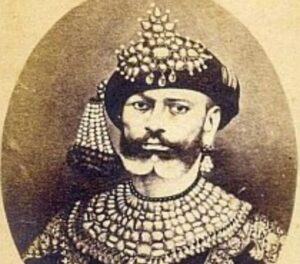
Although Maharaja Khanderao Gaekwad was a Hindu ruler, historical accounts describe his deep respect and admiration for Islamic culture and traditions. In 1865, he ordered the creation of the extraordinary pearl-encrusted carpet, reportedly with the intention of presenting it as a religious offering for the tomb of Prophet Muhammad (SAW) in Medina, Saudi Arabia.
However, the planned gift never reached its intended destination. The Maharaja died in 1870, before the completion of the project, leaving behind a remarkable artistic legacy that would become one of the finest examples of Indian craftsmanship.
A Symbol of Religious Respect and Cultural Harmony
The story of the Pearl Carpet reflects the rich cultural exchanges that existed within many Indian princely states during the 19th century. Royal courts often supported artists, craftsmen and religious institutions beyond their own communities, creating works that represented shared appreciation for beauty, spirituality and human creativity.
Maharaja Khanderao’s decision to commission a gift connected to Islamic heritage demonstrated the complex relationships between different faiths and cultures that shaped India’s history.
A Masterpiece Made With Millions of Pearls
The Pearl Carpet of Baroda is considered one of the most luxurious embroidered textiles ever created.
The masterpiece was part of a five-piece ceremonial set and was decorated with more than 1.5 million Basra pearls, carefully hand-stitched onto the surface. According to art records, the pearls were sourced from the southern Gulf region, including areas around present-day Qatar and Bahrain, where pearl diving had been a major traditional industry for centuries.
The carpet was further enhanced with precious gemstones, including:
Diamonds
Sapphires
Emeralds
Rubies
The combination of pearls, jewels and intricate embroidery reflected both the immense wealth of the Gaekwad dynasty and the extraordinary skill of Indian artisans of the era.
The Importance of Gulf Pearls
For centuries, pearl diving was one of the most important economic activities along the Arabian Gulf coast. Pearls harvested from the waters of Bahrain, Qatar and surrounding regions were highly valued and traded internationally.
Many of these pearls reached global markets through the port of Basra, in present-day Iraq, which became one of the major trading centres for Gulf pearls before the rise of the oil industry transformed the region’s economy.
The use of these pearls in the Baroda carpet connected Indian royal craftsmanship with the wider history of international trade and cultural exchange.
A Journey Through Royal Hands and Global Exhibitions
After its creation, the Pearl Carpet remained associated with the Gaekwad royal family for decades. It was publicly displayed for the first time at the Delhi Durbar of 1903, during the reign of the British Empire in India, while it was still owned by the Gaekwad dynasty.
The carpet later became part of the collection of Maharani Sita Devi of Baroda, one of India’s most famous royal figures. In 1946, she took the priceless artwork with her to Monaco, where she lived after leaving India.
The masterpiece returned to international attention in 1985, when it was exhibited at the Metropolitan Museum of Art in New York, allowing global audiences to appreciate its extraordinary craftsmanship.
A National Treasure at the National Museum of Qatar
Today, the National Museum of Qatar in Doha houses the Pearl Carpet of Baroda as one of the most important highlights of its collection.
The museum describes it as an embroidered masterpiece that represents the artistic achievements of India, the history of Gulf pearls and the cultural connections that existed between different regions of the world.
Legacy of the Pearl Carpet of Baroda
More than 150 years after its creation, the Pearl Carpet of Baroda remains a symbol of artistic excellence, royal generosity and cross-cultural appreciation.
Beyond its priceless materials, the carpet tells a deeper story — of a ruler who sought to create a meaningful spiritual gift, artisans whose skills produced an unmatched masterpiece, and a world where art connected people across religions, regions and civilizations.
The Pearl Carpet of Baroda stands today not only as one of the most valuable textiles ever created but also as a reminder that beauty, respect and cultural exchange can survive through generations.
The Pearl Carpet of Baroda: The 19th-Century Indian Masterpiece Created With Millions of Pearls and a Story of Faith, Art and Royal Grandeur
