

The Kaaba’s Kiswah: A Journey Through More Than 1,500 Years of Faith, History And Tradition
The Kaaba's Kiswah: A Journey Through More Than 1,500 Years of Faith, History And Tradition

The Kaaba’s Kiswah: A Journey Through More Than 1,500 Years of Faith, History And Tradition
Every year, millions of Muslims around the world witness one of Islam’s most sacred and symbolic traditions—the replacement of the Kiswah, the magnificent black cloth that covers the Holy Kaaba in Makkah.
While many believers admire its beauty, fewer know that the Kiswah has undergone remarkable changes over centuries. From the pre-Islamic era to the time of Prophet Muhammad (peace be upon him), through the rule of caliphs, sultans and kings, the covering of the Kaaba has reflected the history of Islamic civilisation itself.
The Kaaba Before Islam
The Kaaba, believed by Muslims to have been originally built by Prophet Ibrahim (Abraham) and his son Prophet Ismail (Ishmael), existed long before the advent of Islam.
Before Prophet Muhammad (peace be upon him) received revelation in 610 CE, the Kaaba was already regarded as a sacred sanctuary by the Arabs, although it had become surrounded by idol worship during the pre-Islamic period.
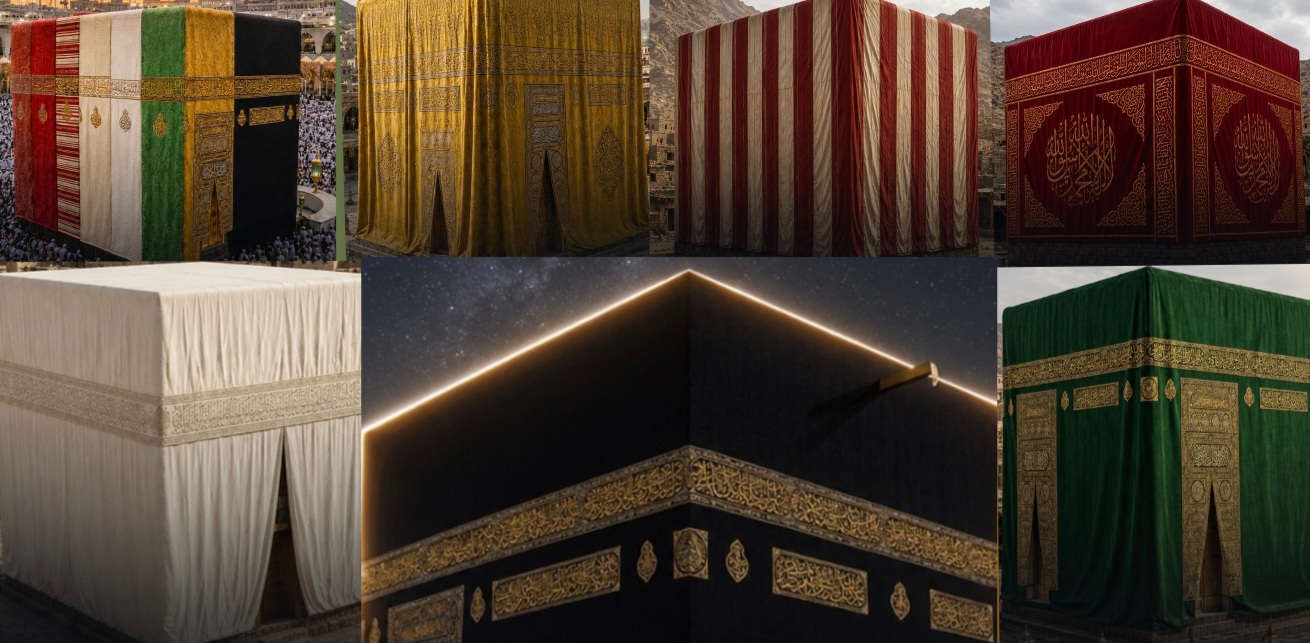
Historical records indicate that the Kaaba was covered with different materials by Arab tribes and rulers. One of the earliest known coverings came from Yemen, whose fine textiles were highly prized throughout Arabia.
The Prophet Muhammad’s Era
Following the Conquest of Makkah in 630 CE (8 AH), Prophet Muhammad (peace be upon him) purified the Kaaba by removing the idols and restoring it to the worship of Allah alone.
Historical narrations indicate that during his lifetime, the Kaaba was covered with striped Yemeni cloth known as Burud, featuring white and red patterns. At that time, the colour of the Kiswah was not fixed, and practical considerations often influenced the choice of fabric.
The Rashidun Caliphate (632–661 CE)
After the Prophet’s passing, the Rightly Guided Caliphs—Abu Bakr As-Siddiq, Umar ibn Al-Khattab, and Uthman ibn Affan—continued the tradition of replacing the Kiswah.
During their rule, the Kaaba was generally draped with white Egyptian linen, known as Qubati, a high-quality fabric produced in Egypt and renowned for its durability and elegance.
White symbolised purity and simplicity, reflecting the values of the early Muslim community.
Abdullah ibn Az-Zubayr and the Red Silk Kiswah
During the First Islamic Civil War, Abdullah ibn Az-Zubayr (624–692 CE), who rebuilt the Kaaba after it was damaged during the siege of Makkah, introduced a luxurious red silk Kiswah.
His contribution remains one of the notable chapters in the history of the Kaaba’s covering.
The Abbasid Era (750–1258 CE)
The Abbasid Caliphate, one of Islam’s greatest empires, introduced several changes to the Kiswah over the centuries.
Historical sources indicate that some Abbasid rulers experimented with green brocade, a colour often associated in Islamic tradition with Paradise.
However, practical experience showed that darker fabrics were more durable, especially as the number of pilgrims visiting Makkah continued to grow.
The Seljuk Period
During the era of the Seljuk Empire (11th–13th centuries), the Kaaba was reportedly covered at one point with yellow brocade, reflecting the artistic styles and royal traditions of the time.
Although short-lived, this period demonstrates that the Kiswah evolved according to different Islamic dynasties.
Why Black Became the Permanent Colour
The transformation to the now-famous black Kiswah began under the Abbasids around the 9th century CE.
Black proved to be more practical because it concealed dust and signs of wear far better than lighter colours, especially as the annual Hajj attracted increasing numbers of pilgrims from across the Islamic world.
Over time, black became the accepted and enduring colour of the Kiswah, a tradition that has continued for nearly 800 years.
The Modern Kiswah
Today, the Kiswah is produced by the King Abdulaziz Complex for the Holy Kaaba Kiswah in Makkah, Saudi Arabia.
The cloth is made from natural black silk and embroidered with verses from the Holy Qur’an using gold-plated and silver-plated threads.
The Kiswah measures approximately 14 metres (46 feet) in height and consists of multiple panels carefully stitched together by skilled artisans.
Each year, hundreds of kilograms of pure silk, gold and silver thread are used in its production, making it one of the world’s most exquisite religious textiles.
Changing the Kiswah
For centuries, replacing the Kiswah has been one of Islam’s most significant religious ceremonies.
Today, the replacement takes place on the 1st of Muharram, marking the beginning of the Islamic New Year.
Specialised teams carefully remove the old covering and install the new Kiswah in a process requiring exceptional precision and coordination.
The ceremony is conducted with dignity and reverence, symbolising renewal while preserving one of Islam’s oldest continuous traditions.
More Than a Cloth
For Muslims, the Kiswah represents far more than a decorative covering.
It symbolises reverence for the House of Allah, the unity of the Muslim Ummah, and the continuity of a tradition that spans more than 1,500 years.
From the simple Yemeni cloths of pre-Islamic Arabia to the magnificent black silk embroidered with gold and silver seen today, the Kiswah tells the story of Islamic civilisation itself—one woven with faith, history, craftsmanship and devotion.
Each time believers gaze upon the Holy Kaaba clothed in its majestic black Kiswah, they witness not only one of the world’s most recognisable religious symbols but also a living tradition that continues to inspire millions across generations.
The Kaaba’s Kiswah: A Journey Through More Than 1,500 Years of Faith, History And Tradition
