

From Barter to Digital Wallets: The Remarkable Evolution of Money Across Human History
From Barter to Digital Wallets: The Remarkable Evolution of Money Across Human History

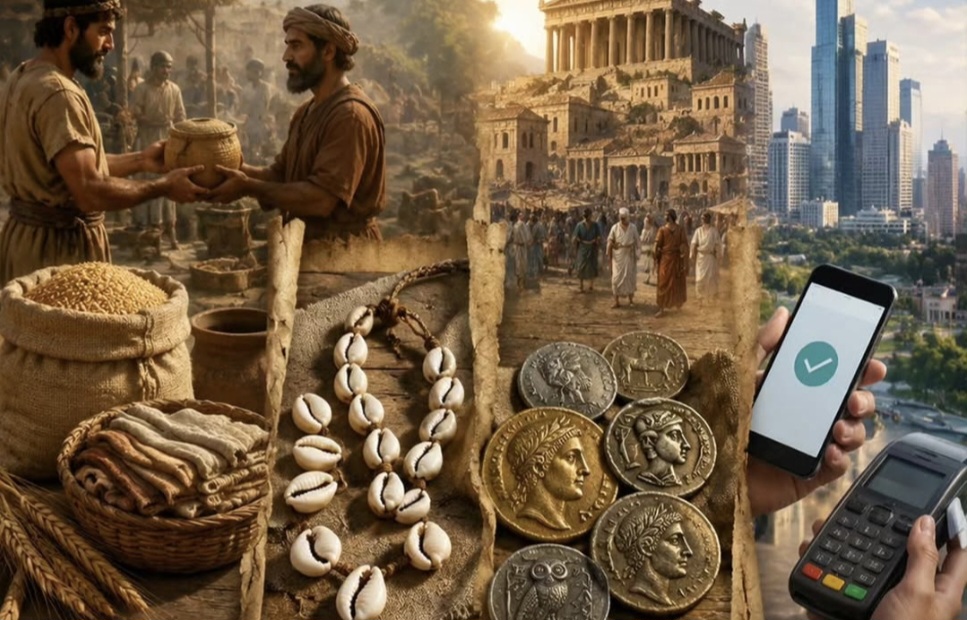
From Barter to Digital Wallets: The Remarkable Evolution of Money Across Human History
The history of money is one of humanity’s greatest innovations, tracing a remarkable journey from simple barter exchanges thousands of years ago to today’s digital payments completed with a single tap on a smartphone. Over centuries, the methods people use to buy, sell and store value have evolved alongside the growth of civilizations, trade, technology and global commerce.
The Barter System: Before 3000 BCE
Long before coins or paper currency existed, people relied on the barter system, exchanging goods and services directly for other items of value. Farmers traded crops for livestock, hunters exchanged meat for tools, and craftsmen swapped handmade products for food or clothing.
Although effective in small communities, barter had serious limitations. Transactions depended on both parties wanting exactly what the other offered, a challenge economists describe as the “double coincidence of wants.”
Cowrie Shells and Commodity Money
As trade expanded, societies sought more convenient forms of exchange. Cowrie shells became one of the world’s earliest widely accepted currencies.
Archaeological evidence shows cowrie shells were used as money in parts of China as early as 1200 BCE, while across Africa, South Asia and the Pacific Islands, they remained in circulation for centuries and, in some regions, until the 19th century.
Other valuable commodities also served as money, including beads, animal skins, tea, tobacco and cocoa.
Salt: The Ancient Currency
Salt was among history’s most valuable commodities because of its importance in preserving food before refrigeration.
The Romans, Greeks and several African kingdoms used salt as a medium of exchange. The English word “salary” is believed to originate from the Latin word salarium, reflecting payments associated with salt.
In parts of West Africa, blocks of salt were once traded almost as valuable as gold.
The Birth of Metal Coins
Around 600 BCE, the ancient Kingdom of Lydia—located in present-day Türkiye—is widely credited with introducing the world’s first standardized metal coins.
Made primarily from electrum, a natural alloy of gold and silver, these coins revolutionized commerce by providing standardized values that simplified trade and taxation.
The innovation quickly spread throughout Greece, Persia, Rome and later much of the world.
Paper Money Revolution
China pioneered paper currency during the Tang Dynasty (618–907 CE), with widespread government-issued banknotes emerging during the Song Dynasty (960–1279 CE).
Paper money allowed merchants to conduct large transactions without transporting heavy coins, transforming long-distance trade.
Centuries later, paper currency spread across Europe before becoming the dominant form of money worldwide.
The Gold Standard Era
During the 19th and early 20th centuries, many nations adopted the gold standard, under which paper currency could be exchanged for a fixed quantity of gold.
The system promoted confidence in currencies and facilitated international trade. However, following the economic disruptions of the Great Depression and the two World Wars, most countries gradually abandoned the gold standard.
The United States formally ended the direct convertibility of the dollar to gold in 1971, marking the transition to today’s fiat currency system.
Credit Cards Change Consumer Spending
The next major transformation came in the 1950s with the introduction of modern credit cards.
The launch of the Diners Club Card in 1950 is widely regarded as the beginning of the modern credit card industry. It was followed by BankAmericard—later known as Visa—and Master Charge, now Mastercard.
Credit cards enabled consumers to purchase goods immediately while paying later, fundamentally changing retail banking and consumer finance.
The Digital Payments Revolution
The rise of the internet and smartphones in the 21st century ushered in a new era of digital finance.
Online banking, mobile money, QR-code payments, contactless cards, e-wallets and instant payment platforms have transformed the global financial system.
Today, billions of transactions are completed every day through digital platforms, allowing individuals and businesses to transfer funds almost instantly across borders without handling physical cash.
Financial technologies such as blockchain, digital currencies and artificial intelligence are also reshaping the future of global finance.
Money Continues to Evolve
From bartering livestock thousands of years ago to sending money instantly with a mobile phone, the evolution of money reflects humanity’s continuous pursuit of more efficient, secure and trusted ways to exchange value.
As technology continues to advance, experts believe the next chapter of monetary history could include wider adoption of central bank digital currencies, enhanced financial inclusion through fintech innovation, and increasingly cashless economies.
The story of money remains not only a history of currency, but also a testament to the growth of human civilization, commerce, innovation and trust over thousands of years.
From Barter to Digital Wallets: The Remarkable Evolution of Money Across Human History
