


LEAH: How Theatre Is Keeping a Missing Girl’s Memory Alive
There are some disappearances that refuse to end. Long after the headlines fade, the families continue to wait, questions remain unanswered and the absence of a loved one becomes a permanent part of everyday life.
It is this painful reality that playwright and director Jerry Adesewo confronts in LEAH, a theatre production inspired by the unresolved story of Leah Sharibu, the schoolgirl abducted by Boko Haram in Dapchi, Yobe State, in 2018.
Rather than presenting the production as a conventional retelling of the abduction, Adesewo uses theatre to confront a more uncomfortable question: What happens when a nation stops talking about those who disappeared?
Leah Sharibu was among 110 schoolgirls abducted from the Government Girls’ Science and Technical College, Dapchi, in February 2018. While most of the girls were eventually returned, Leah remained behind. Years later, her fate remains shrouded in uncertainty, leaving her family and the wider public without definitive closure.
Her story, once at the centre of national and international attention, has gradually receded from public discourse.
It is precisely this fading of memory that LEAH seeks to challenge.
The production’s exclusive premiere, held on a rainy Saturday night, transformed the stage into a space of remembrance, uncertainty and interrogation. Rather than attempting to recreate Leah’s captivity as a documentary, Adesewo creates an imagined Leah who returns to speak.
Through this fictionalised theatrical figure, the playwright moves beyond the story of one abducted girl to explore the broader experiences of children and families caught in Nigeria’s continuing cycle of insurgency, kidnapping, displacement and violence.
At its heart, LEAH is therefore less about reconstructing the past than confronting society’s relationship with memory.
The imagined Leah becomes a reminder that disappearance should not automatically lead to forgetting. Her return to the stage forces the audience to confront what has happened to the memory of the real girl whose absence once generated widespread outrage.
In a country where one tragedy is frequently overtaken by another, the production makes forgetting itself part of the tragedy.
An Empty Stage, A Missing Girl
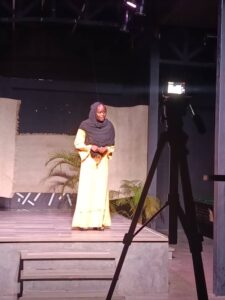
One of the production’s most striking features is its minimalist aesthetic.
Adesewo does not attempt to fill the stage with elaborate scenery or reproduce every location associated with Leah’s story. Instead, the relative emptiness of the stage becomes part of the storytelling.
The choice is significant.
The story revolves around an absence — a girl whose physical presence has been denied to her family and whose fate remains unknown. The empty stage consequently becomes a visual representation of that absence.
There is also an absence of certainty and closure, and the production allows that uncertainty to remain visible rather than manufacturing answers that reality has not provided.
The lighting design reinforces this approach.
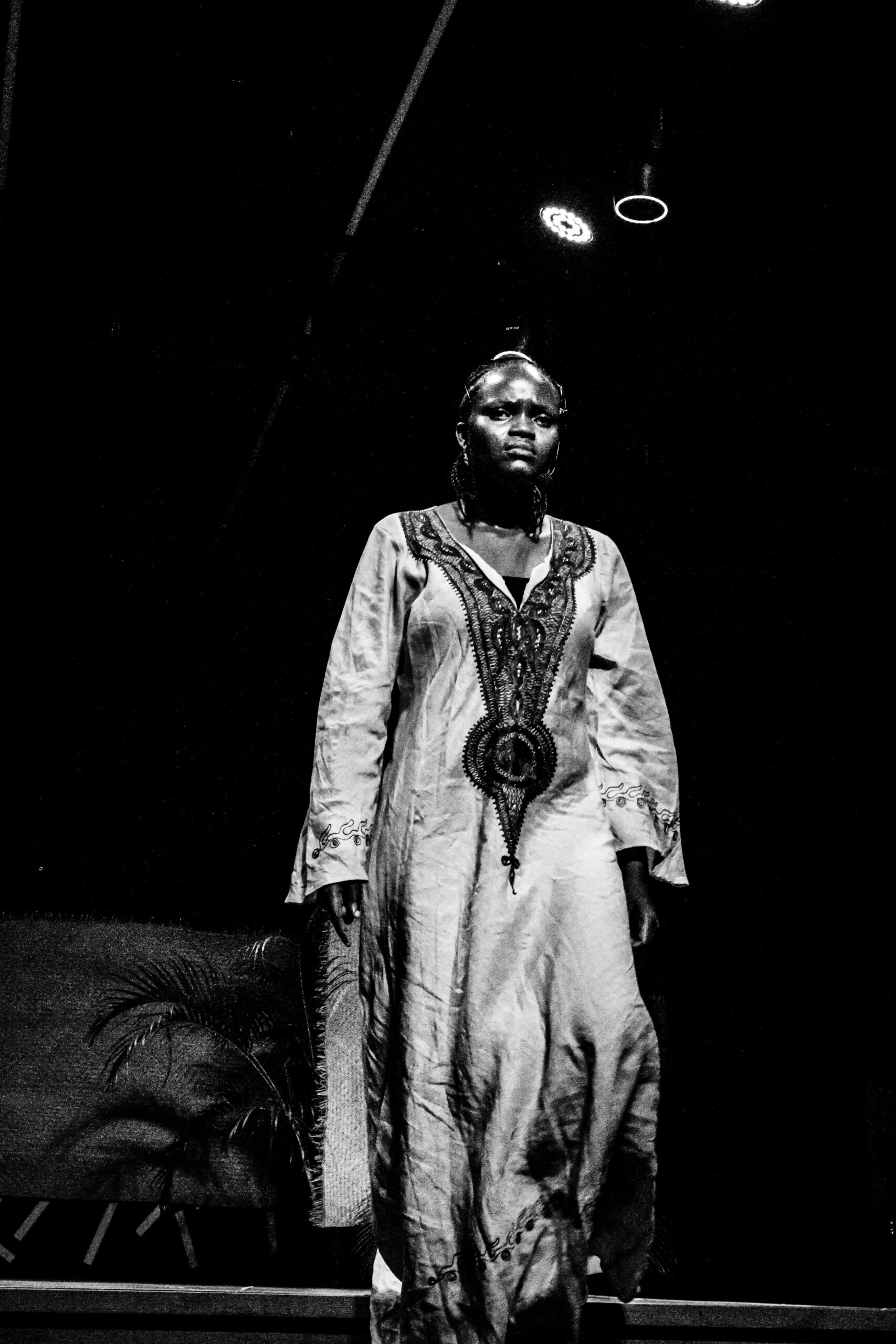
At one point, Leah appears almost swallowed by darkness, standing alone within a concentrated beam of light descending from above. The image captures both vulnerability and interrogation. She is illuminated, yet surrounded by an overwhelming darkness.
That darkness becomes a metaphor for the unanswered questions surrounding her fate.
Where is Leah? What happened to her? What has become of the national attention that once surrounded her story?
The production does not pretend to have the answers.
Instead, it allows the questions to remain suspended in the theatrical space.
This restraint saves the production from turning a painful real-life tragedy into spectacle. The story already contains sufficient horror; it requires no theatrical exaggeration to make it disturbing.
Voice, movement, silence, body language, light and space consequently become the principal tools of storytelling, producing an atmosphere that is intimate rather than sensational.
Giving Leah a Voice
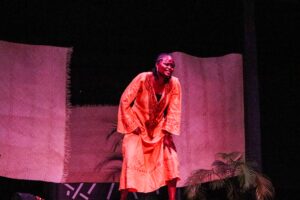 Folashade Olafisoye, in the role of Leah, provides the emotional centre of the production.
Her performance gives the imagined character vulnerability, fear, resilience and an interior life, transforming Leah from an abstract name associated with a national tragedy into a recognisable human presence.
Ezra Ibrahim, playing the Captor/Commander, establishes the atmosphere of threat and psychological menace surrounding Leah. His character’s presence reinforces the oppressive environment in which vulnerability and survival collide.
Olayiwola Banji, in the dual roles of Shauib/Idris, adds another dimension to the production’s exploration of identity, allegiance and survival within a world distorted by violence.
Felicia Jerry-Adesewo, playing Leah’s mother, brings the national tragedy into the intimate space of family.
Through her performance, Leah ceases to be merely a schoolgirl whose abduction once made newspaper headlines. She becomes somebody’s daughter — a child whose absence continues to shape the life of a mother waiting for her return.
The mother’s presence is a powerful reminder that an abduction does not end when the headlines disappear. For families, uncertainty can become a lifelong experience.
Theatre as Public Memory
As both playwright and director, Adesewo appears conscious of the responsibility that comes with staging a story whose real-life ending remains unknown.
The production does not claim to recreate Leah Sharibu’s actual experience or resolve the mystery surrounding her fate. Instead, it uses theatrical imagination to reopen a conversation that public attention has gradually abandoned.
That distinction gives LEAH much of its ethical strength.
Theatre cannot rewrite history, but it can prevent history from being forgotten.
Nigeria’s experience with abductions has often followed a familiar pattern: a kidnapping occurs, public outrage follows, there are demands for action, headlines dominate the news cycle and, eventually, attention moves elsewhere as another crisis emerges.
The stories of Chibok and Dapchi exist within this wider national experience, alongside numerous other cases of schoolchildren and communities caught in the violence of insurgency and kidnapping.
The danger, the production suggests, is not only that people are abducted. It is that their memories can eventually be displaced by the next emergency.
LEAH resists that displacement.
It asks theatre to perform the role that public memory sometimes fails to perform — to hold a name in place.
A Memorial and a Warning
The production consequently functions both as a memorial and a warning.
It memorialises a girl whose fate remains uncertain while warning against the normalisation of disappearance.
Its advocacy is particularly effective because it does not simply instruct the audience on what to think. Instead, it makes forgetting uncomfortable.
The absence of closure becomes part of the message.
The audience may leave without knowing what ultimately happened to Leah Sharibu, but they are reminded that uncertainty is itself a reality that deserves attention.
And perhaps that is the most significant intervention of LEAH.
Theatre cannot tell us with certainty what became of Leah Sharibu. It cannot return her to her family or restore the years lost to captivity and uncertainty.
But it can offer another form of restitution: it can return her to public consciousness.
That is the quiet but powerful intervention Jerry Adesewo makes with LEAH.
At a time when Nigeria’s attention is constantly consumed by the next crisis, the production asks audiences to pause, look back and remember those whose stories have been pushed to the margins.
Because a missing person can disappear once from home.
But when society forgets, they risk disappearing a second time.
LEAH refuses to let that happen.
It brings her back into the light.
