

The Humble Home of Prophet Muhammad (SAW): A Timeless Lesson in Faith, Simplicity and Contentment
The Humble Home of Prophet Muhammad (SAW): A Timeless Lesson in Faith, Simplicity and Contentment


The Humble Home of Prophet Muhammad (SAW): A Timeless Lesson in Faith, Simplicity and Contentment
Long before the magnificent domes, marble courtyards and vast expansions of the Prophet’s Mosque transformed the landscape of Madinah, the area around the mosque was home to a collection of remarkably modest dwellings.
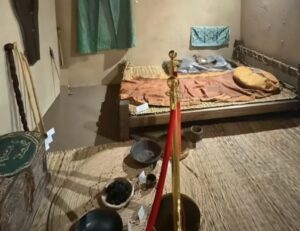

Among them were the simple rooms where Prophet Muhammad (SAW) lived with his wives and family.
These homes were not palaces. They were small, functional spaces constructed from the materials available in seventh-century Madinah, including mud bricks, with roofs made from palm branches. Historical descriptions of the Prophet’s wives’ dwellings indicate that the rooms were small and located immediately beside the mosque.
Today, the original homes are no longer standing in their historical form. The area became incorporated into the expanding Prophet’s Mosque (Al-Masjid an-Nabawi), while the chamber of Aisha (RA), where the Prophet (SAW) spent his final days and was buried, became part of what is now known as the Sacred Chamber.
But the memory of those humble rooms continues to tell one of the most powerful stories in Islamic history.
From Makkah to Madinah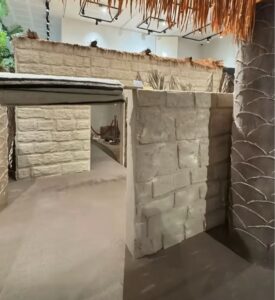
Prophet Muhammad (SAW) was born in Makkah around 570 CE, traditionally known as the Year of the Elephant. He received the first revelation of the Qur’an at the age of 40, around 610 CE, beginning the prophetic mission that would transform the religious and social history of Arabia.
After more than a decade of persecution and growing opposition in Makkah, the Prophet (SAW) migrated to Madinah in 622 CE in the event known as the Hijrah.
The migration marked a turning point. In Madinah, the Prophet (SAW) established a community based on faith, brotherhood, justice and responsibility.
The mosque became the heart of that community.
Beside it stood the small homes of the Prophet (SAW) and his wives.
Rather than separating himself from the people through grandeur, the Messenger of Allah (SAW) lived close to the mosque and close to the community he served.
A Home Built on Simplicity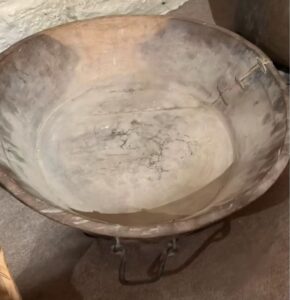
Descriptions of the dwellings associated with the Prophet’s household paint a picture of extraordinary simplicity.
The rooms were small, with mud-brick walls and palm-branch roofing. One historical guide describes the individual huts as approximately 5 metres by 4 metres, although measurements should be understood as historical estimates rather than modern architectural surveys.
The simplicity of the surroundings did not diminish the importance of what happened there.
Within these modest rooms, revelation was remembered, knowledge was taught, families lived, guests were received and the Prophet’s private life became part of the Sunnah preserved by his companions and wives.
The homes were therefore small in physical size but immense in historical and spiritual significance.
The Household of the Prophet (SAW)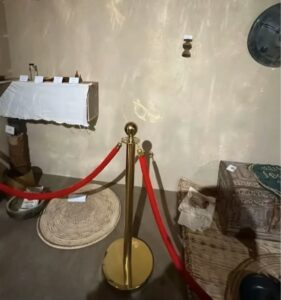
The Prophet’s wives, known as the Mothers of the Believers, lived in individual rooms adjoining the mosque.
Among those dwellings was the room of Aisha (RA), daughter of Abu Bakr (RA), who became one of the most important transmitters of knowledge about the Prophet’s life.
It was in Aisha’s room that the Prophet (SAW) spent his final illness after receiving permission from his wives to remain there. According to the historical account, he died there on Monday, 12 Rabi al-Awwal, 11 AH, corresponding to 632 CE in the commonly used conversion, although exact Gregorian conversions of early Islamic dates can vary.
He was subsequently buried in the same room where he died, following the well-known principle that prophets are buried where they pass away.
Years later, Abu Bakr (RA) and Umar ibn al-Khattab (RA) were also buried beside him, in the Sacred Chamber.
When Food Was Scarce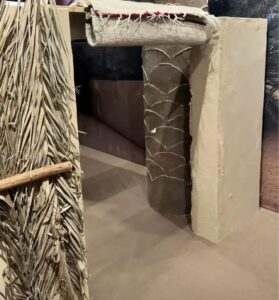
Perhaps one of the strongest lessons from the Prophet’s household is found not in architecture, but in the testimony of Aisha (RA).
She reported that there were months when no cooking fire was lit in the homes of the family of Muhammad (SAW), and their food consisted of dates and water.
Another authentic narration records that the household of Muhammad (SAW) did not regularly eat its fill of barley bread for two consecutive days before the Prophet’s death.
This was not because the Prophet (SAW) lacked status or importance.
By the final years of his life, he was the leader of a growing Muslim community and a central figure in Arabia. Yet personal luxury was never the measure of his success.
His life demonstrated that leadership could coexist with humility.
The Prophet’s Priorities
The Prophet Muhammad (SAW) taught through both his words and his conduct.
His life placed enormous emphasis on worship, justice, mercy, honesty, patience, generosity and service to others.
His modest home therefore became more than a place where he slept. It reflected a broader principle of zuhd — not necessarily rejecting lawful worldly possessions, but refusing to allow material possessions to control the heart.
The Prophet (SAW) could have accumulated wealth, yet his life consistently demonstrated restraint and generosity.
His concern was not the size of his home but the condition of his heart and the wellbeing of those around him.
The Home That Became a Sacred Place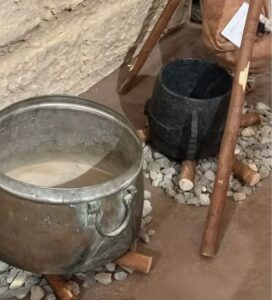
The history of Aisha’s room is particularly remarkable.
The Prophet (SAW) died there in 632 CE, and his burial place eventually became enclosed within the Sacred Chamber.
The expansion of the Prophet’s Mosque over subsequent centuries transformed the physical surroundings. Historical accounts record that during the Umayyad period, under Umar ibn Abd al-Aziz, the chamber was enclosed by walls, eventually becoming protected as part of the mosque complex.
Today, millions of Muslims visit Madinah every year and stand near the area of the Sacred Chamber to offer salutations upon the Prophet (SAW).
What was once an extremely modest room has therefore become one of the most revered locations in the Islamic world.
A Powerful Lesson for Modern Life
The story of the Prophet’s home speaks directly to a world increasingly fascinated by wealth, architecture, status and material success.
Modern society often measures achievement through the size of a house, the value of a car, the clothes someone wears or the amount of money displayed publicly.
The Prophet’s life presents a radically different standard.
His home was simple.
His possessions were limited.
His meals could be modest.
Yet his influence crossed generations and continents.
More than 1,400 years after his death, his teachings continue to shape the lives of hundreds of millions of Muslims around the world.
That contrast is perhaps the greatest lesson of the house.
A small home can contain a great life.
The Legacy of a Humble Dwelling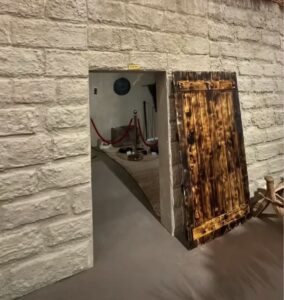
The physical rooms where the Prophet (SAW) lived are largely part of history now, transformed by the centuries of development surrounding Al-Masjid an-Nabawi.
But their message remains.
The Prophet Muhammad (SAW) did not teach Muslims that success meant possessing the largest house or accumulating the greatest wealth.
His life showed that honour can exist alongside simplicity, leadership alongside humility, and greatness alongside contentment.
His home reminds believers that wealth is a responsibility, not necessarily a measure of worth.
And perhaps most importantly, it reminds humanity that the greatness of a person is not determined by the walls surrounding them, but by the character, faith and mercy they carry within those walls.
The Prophet (SAW) lived simply, served faithfully and left behind a legacy that no palace could have created.
His house was humble. His mission was immense. His character was his greatest wealth.
May Allah’s peace and blessings be upon Prophet Muhammad, his family and his companions.
The Humble Home of Prophet Muhammad (SAW): A Timeless Lesson in Faith, Simplicity and Contentment
