

The Lost Ring of the Prophet SAW: A Sacred Relic, A Well in Madinah and the Beginning of A Troubled Era
The Lost Ring of the Prophet SAW: A Sacred Relic, A Well in Madinah and the Beginning of A Troubled Era

The Lost Ring of the Prophet SAW: A Sacred Relic, A Well in Madinah and the Beginning of A Troubled Era
There are moments in Islamic history that appear simple on the surface but carry a remarkable depth of historical and spiritual significance.
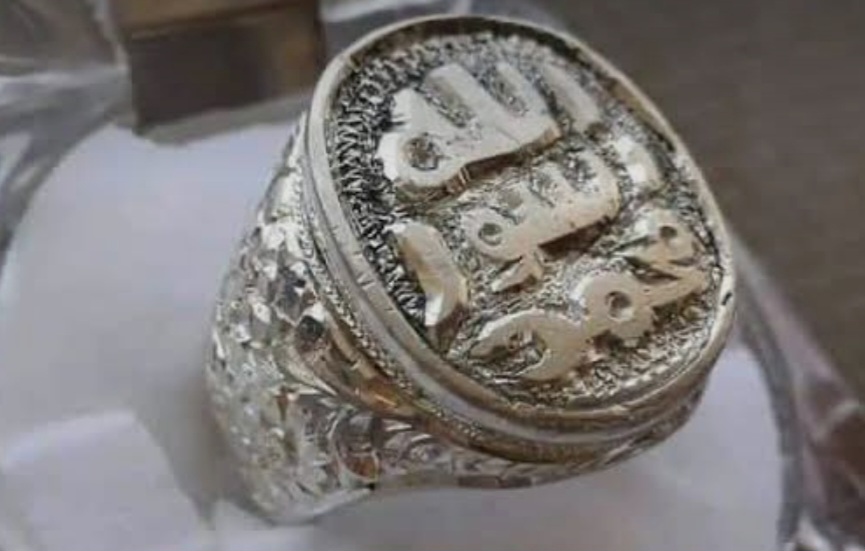
One of them is the story of a silver ring once worn by the Prophet Muhammad SAW—a ring engraved with the words “Muhammad Rasul Allah”—which later passed into the hands of the first three caliphs before disappearing into a well in Madinah during the caliphate of Uthman ibn Affan RA
The story is preserved in authentic hadith collections. But over the centuries, another historical association emerged: the loss of the ring became closely linked in some early accounts with the beginning of the political unrest that eventually engulfed Uthman’s caliphate.
That connection, however, must be presented carefully. The authentic hadith establishes the ring’s history and its loss in the Well of Aris. It does not establish that the loss of the ring caused the later fitnah. That association belongs to historical reports and interpretation, not to a direct prophetic statement.
A Ring Connected to the Messenger of Allah SAW
The Prophet SAW used a signet ring. According to authentic narrations in Sahih al-Bukhari and Sahih Muslim, the ring was made of silver and bore the inscription:
“Muhammad Rasul Allah” — Muhammad, the Messenger of Allah.
The inscription was arranged in a particular manner, with the words placed one below another. The ring served as a seal used by the Prophet SAW, particularly in correspondence with rulers and leaders outside Arabia.
Some popular retellings describe the ring as having an Abyssinian or Ethiopian stone. However, the strongest widely cited narrations about the specific ring later inherited by the caliphs identify it as a silver signet ring engraved with “Muhammad Rasul Allah.” The authentic narrations do not clearly establish the popular claim that its stone was specifically an Abyssinian stone.
From Abu Bakr to Umar, Then Uthman
After the death of the Prophet SAW, the ring passed to Abu Bakr al-Siddiq RA, the first caliph.
It later passed to Umar ibn al-Khattab RA, and after him to Uthman ibn Affan RA.
This succession is recorded in both Sahih al-Bukhari and Sahih Muslim. The ring therefore became more than a personal possession. It was a tangible object that had belonged to the Messenger of Allah SAW and was subsequently held by the first three caliphs of Islam.
The Well of Aris
The turning point came during the caliphate of Uthman RA.
The ring was lost at Bir Aris, or the Well of Aris, near the area of Quba in Madinah.
A narration recorded by Imam al-Bukhari states that Uthman RA was sitting beside the well when he removed the ring. As he was handling it, it slipped from his hand and fell into the well.
The search continued for three days. According to the narration, the well was drained, but the ring could not be found.
Another narration in Sahih Muslim also confirms that the ring remained in the possession of the Prophet SAW, then Abu Bakr, Umar and Uthman, until it fell into the Well of Aris.
The loss was therefore not merely the disappearance of an ordinary piece of jewellery. It was the disappearance of a personal relic connected to the Messenger of Allah SAW and subsequently held by three of the most important leaders of the early Muslim community.
Did the Prophet SAW Warn Uthman About the Well?
This is one of the most repeated claims in popular versions of the story.
However, it is important to distinguish between what is established by authentic hadith and what is not.
The authentic narrations cited above clearly record the ring’s passage from the Prophet SAW to Abu Bakr, Umar and Uthman, and its eventual loss in the Well of Aris.
But the claim that the Prophet SAW specifically warned Uthman RA, saying that he should be careful about the Well of Aris because of the ring, is not established in the authentic narrations cited here.
Likewise, the idea that the Prophet SAW directly indicated that the loss of the ring would mark the beginning of the fitnah is not something that should be presented as an authenticated prophetic statement.
There is, however, a separate narration in Sunan Abi Dawud that connects the loss of the ring with the beginning of disagreement surrounding Uthman. That report says that people did not disagree concerning Uthman until the signet ring fell from his hand. This is a historical report associated with the incident, but it should not be confused with a direct prophecy that the ring’s disappearance caused the civil conflict.
The Six Peaceful Years and the Six Years of Crisis
Uthman ibn Affan RA ruled as the third caliph for approximately 12 years, from 644 to 656 CE.
His caliphate is often described in two broad phases.
The first approximately six years were generally marked by stability and continued expansion of the Muslim state.
During the later years of his rule, however, serious political and social tensions emerged. Complaints, opposition and unrest grew in different parts of the expanding Muslim empire.
The situation eventually escalated into rebellion. Uthman RA was besieged in his home in Madinah and was killed in 656 CE.
His death became one of the defining moments in early Islamic history and contributed to the first major civil war, or First Fitnah, which would profoundly affect the Muslim community.
The Prophet SAW had also spoken of a calamity that would befall Uthman. In an authentic narration, when Abu Musa al-Ash’ari was guarding a garden, the Prophet SAW gave Abu Bakr and Umar glad tidings of Paradise, and when Uthman arrived, the Prophet SAW told him to enter and gave him glad tidings of Paradise along with a calamity that would befall him.
Another narration records the Prophet SAW referring to Uthman as someone who would be wrongfully killed during a fitnah.
The Ring and the Fitnah: What Can We Say With Certainty?
The most responsible way to understand the story is to separate established fact from later interpretation.
What is firmly established:
The Prophet Muhammad SAW possessed a silver signet ring.
It bore the inscription “Muhammad Rasul Allah.”
The ring passed after him to Abu Bakr RA.
It then passed to Umar RA.
It later came into the possession of Uthman RA.
It fell into the Well of Aris during Uthman’s caliphate.
The ring was searched for over three days but was not recovered.
What should be treated cautiously:
That the ring had a specifically Abyssinian stone.
That the Prophet SAW specifically warned Uthman about the Well of Aris.
That the loss of the ring itself caused the political fitnah that later emerged.
The authentic sources establish the incident. The interpretation that the loss of the ring marked the beginning of the crisis is a historical association, not a proven cause-and-effect relationship.
A Lost Ring and a Lasting Historical Memory
The mystery of the ring continues to fascinate Muslims because it connects several extraordinary chapters of Islamic history in one story.
It was worn by the Messenger of Allah SAW
It passed through the hands of Abu Bakr and Umar RA
It was held by Uthman RA, the caliph whose reign would end in one of the most tragic episodes in early Islamic history.
Then, at the Well of Aris, the ring disappeared.
The ring was never recovered.
Whether one views the incident simply as the loss of a sacred historical relic or considers the later historical association with the First Fitnah, the story remains a powerful reminder of the fragility of worldly possessions—and of how a single object can become connected to the memory of an entire civilisation.
The ring was lost in a well. But the story surrounding it has never disappeared.
And perhaps that is why, more than fourteen centuries later, the Well of Aris remains part of one of the most intriguing stories in the history of Islam.
The Lost Ring of the Prophet SAW: A Sacred Relic, A Well in Madinah and the Beginning of A Troubled Era
