


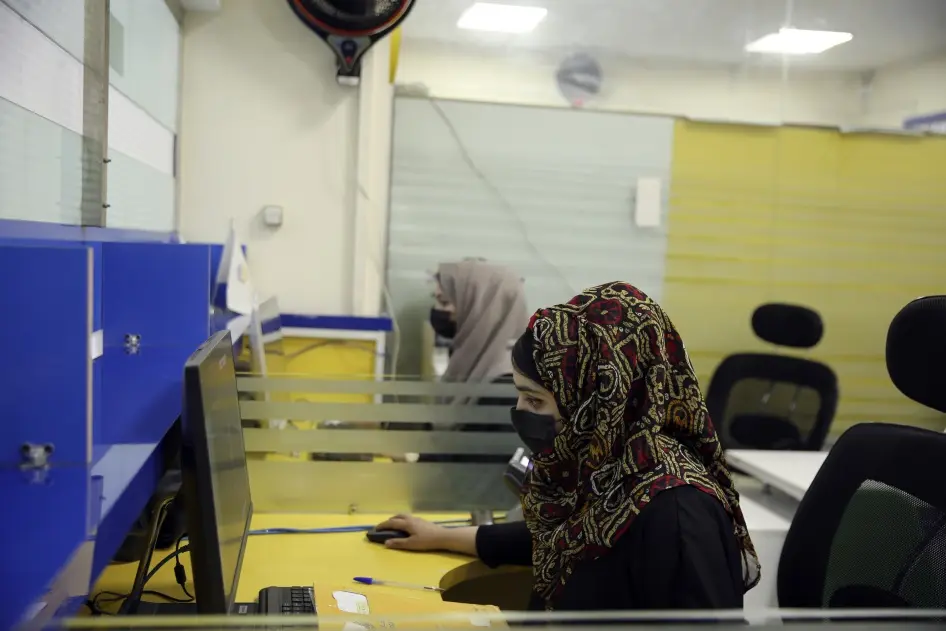
A Generation Interrupted: Afghanistan’s Vanishing Women Workforce Raises Alarm
By Matthew Eloyi
A quiet crisis is unfolding across Afghanistan’s classrooms and clinics, one that may reshape the country’s future for decades. Behind the statistics are empty desks, understaffed hospitals, and a generation of girls cut off from the very path that once led women into vital public service roles.
A new report by UNICEF paints a troubling picture: by 2030, Afghanistan could lose more than 25,000 female teachers and healthcare workers. These are not just numbers, but the backbone of services that millions of women and children rely on every day.
UNICEF described the situation as a looming dual crisis, unless current restrictions on girls’ education and women’s employment are lifted.
At the heart of the issue is a compounding problem. As experienced female professionals gradually leave the workforce through retirement, migration, or other factors, there are fewer trained women to replace them. The pipeline that once sustained these professions is narrowing rapidly, largely due to policies that have kept girls out of secondary schools and universities.
According to the report, the departure of already trained female professionals combined with the systematic exclusion of the next generation of girls from secondary and higher education, would prevent the replacement of those who leave the workforce.
UNICEF said the country could lose up to 20,000 women teachers and 5,400 healthcare workers by the end of the decade.
The roots of this crisis trace back to September 2021, when girls were barred from continuing education beyond primary school. Since then, opportunities have steadily diminished, leaving millions in limbo.
Since the Afghan government banned girls from secondary education in September 2021, the UN agency said, more than one million girls have been deprived of their right to continue learning.
It said that the ban remains in place until 2030 and over two million girls would have been denied education beyond primary school.
READ ALSO: The Children at the School Gate: An Appeal for the Forgotten Ones in the FCT Strike
Today, the impact is stark. Girls in Afghanistan, it said, are currently barred from attending classes above Grade six, while women are prohibited from attending universities until further notice. For many, dreams of becoming teachers, doctors, and nurses have been put on indefinite hold.
Beyond individual aspirations, the consequences ripple through communities. Female teachers are essential in a society where cultural norms often limit interactions between men and women, particularly in education. Similarly, female healthcare workers play a critical role in maternal and child health, often serving as the only accessible providers for women in conservative areas.
Without them, access to basic services could deteriorate sharply, especially in rural regions where alternatives are scarce.
UNICEF urged the Afghan government to immediately lift the ban on secondary education for girls and called on the international community to remain steadfast in its support for Afghan girls’ fundamental right to education.
For now, Afghanistan stands at a crossroads. The choices made today will determine whether a generation of girls remains on the margins or becomes the force that rebuilds the nation’s classrooms and clinics.
