


EXECUTIVE SUMMARY
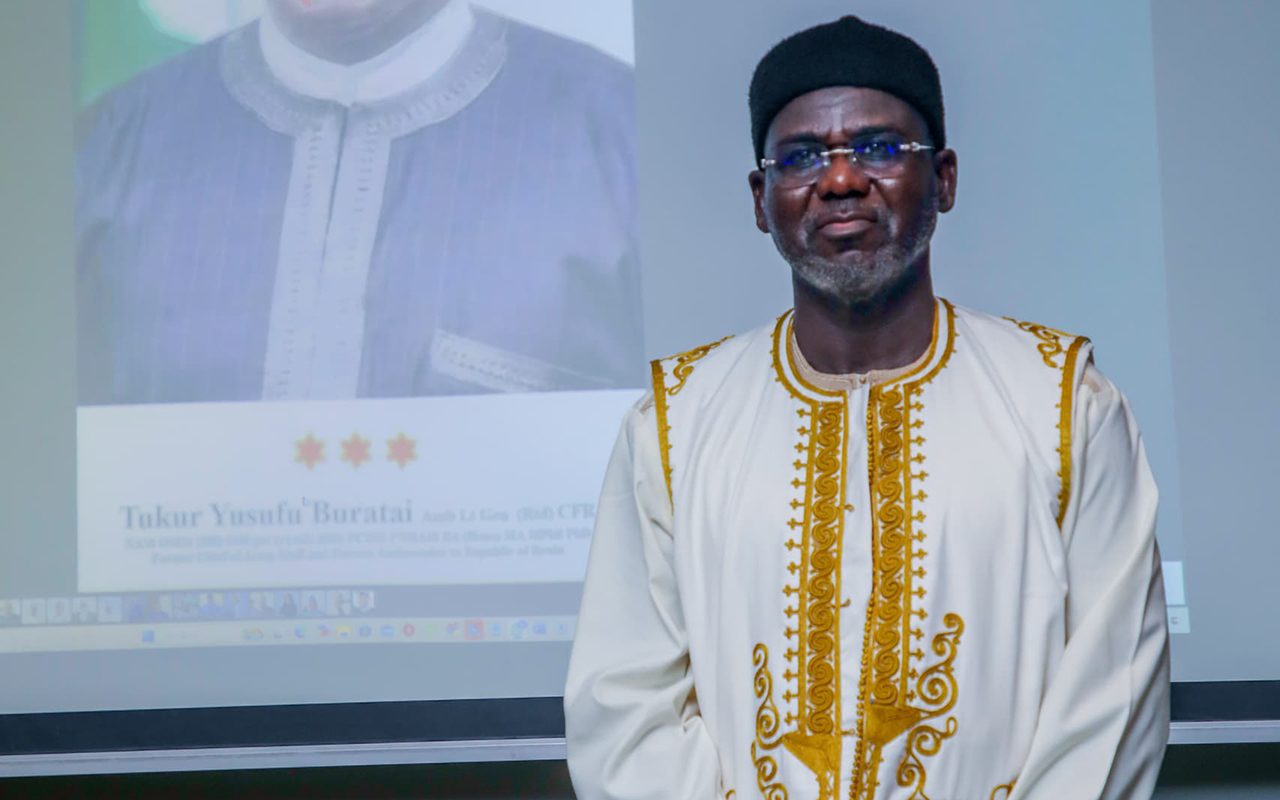
Lt Gen Tukur Buratai’s Armed Forces CELEBRATIONS AND REMEMBERANCE DAY
(AFCRD) lecture stands as one of the most coherent doctrine-level security blueprints ever articulated by a former Chief of Army Staff. His central thesis is that Nigeria has arrived at a critical crossroads where traditional military-centric responses have become not only unsustainable but counterproductive. The lecture diagnoses insecurity as a national emergency driven by structural overstretch, technology gaps, and a sophisticated criminal ecosystem that thrives on financial networks and governance deficits. His analysis reframes the problem from a regional tactical nuisance to an existential challenge requiring a whole-of-society reset.
PART I: THE DIAGNOSIS – THE SYSTEM BEHIND THE GUN
Buratai’s most profound contribution is his conceptual shift from viewing insurgents and bandits as isolated actors to understanding them as symptoms of a deeper ecosystem. He asserts unequivocally that the key threat is the system behind the gun, not the gun itself. This reframing carries enormous strategic weight: fighters are merely the downstream effects of financial pipelines, logistical supply chains, recruitment networks, and ideological echo chambers. By extension, kinetic violence is a symptom, while the true upstream threats are financial choke points and technological lag. Until those are addressed, military action is merely cosmetic. As Buratai memorably puts it, killing a hundred bandits at once achieves nothing if the money pipeline remains open; it is simply mowing the grass.
On the operational front, Buratai warns that Nigeria’s current security model is fundamentally broken. The military is dangerously overstretched, conducting more than thirty-two routine internal policing operations simultaneously. This relentless internal deployment has steadily eroded its primary war-fighting capacity, leaving the country exposed to conventional external threats at a moment when the Sahel is collapsing into chaos. He catalogues the multi-dimensional nature of the crisis with clinical precision: Boko Haram and ISWAP in the North-East, banditry and mass kidnapping in the North-West, separatist agitations in the South-East, and oil bunkering in the South-South. Each region presents a distinct threat, yet all are connected by the same underlying structural failures.
Buratai anchors his diagnosis in root causes that are fundamentally developmental rather than tactical. He points to endemic underdevelopment, pervasive poverty, chronic youth unemployment, dilapidated infrastructure, and the proliferation of ungoverned spaces where the Nigerian state is effectively absent These conditions are further compounded by ideological and social vulnerabilities, as disenfranchised youth become easy prey for extremist recruiters. In his view, no quantity of bullets can resolve these drivers because they are not military problems; they are failures of governance and economics that manifest as violence.
PART II: THE STRATEGIC WAY FORWARD – A FIVE-POINT ROADMAP
In response to this grim diagnosis, Buratai proposes five interconnected policy recommendations that together form a comprehensive national security reset.
First, he calls for a radical rethink of the force structure. The military must be accelerated toward full professionalization and specialisation, with a strategic refocus on high-intensity combat and external defence. This requires a phased but definitive withdrawal from routine internal policing duties. To fill that vacuum, he advocates for a massively expanded and professionalised Nigeria Police Force, targeting approximately 1.5 million officers. This figure aligns with the United Nations recommended police-to-citizen ratio of one to four hundred and fifty, whereas Nigeria currently languishes around one to six hundred. Without this fundamental rebalancing, the military will remain perpetually distracted from border defence, maritime threats, and the spillover from the Sahelian crises.
Second, Buratai envisions a new security ecosystem that moves decisively beyond the military-only paradigm. He champions a whole-of-society approach that demands genuine synergy between government institutions, civil society organisations, traditional rulers, the media, religious leaders, and crucially, the youth. This is not a rhetorical flourish; it is a practical acknowledgement that state security apparatuses alone can not reach every village, forest, or urban slum where recruitment and radicalisation occur. The burden must be shared, and legitimacy must be rebuilt from the ground upward.
Third, he insists on the indivisibility of security and development. Buratai argues compellingly that these two domains should never be addressed in isolation but treated as intrinsically linked elements of the same national project. Development, in his framework, is a prerequisite for stabilisation. Building roads, railways, social services, and job-creating industries is not an adjunct to security policy; it is the security policy. By extending state presence into ungoverned spaces and offering viable economic alternatives to criminality, Nigeria can remove the very drivers of instability at their source.
Fourth, he places technology and local industrial capacity at the heart of the new doctrine. To close the widening technology gap, Buratai proposes the creation of a National Defence Innovation Fund, financed through public-private partnerships, to drive research and development in cyber defence, drone technology, satellite communications, and renewable energy for forward operating bases. This fund would also serve to revitalise the Defence Industries Corporation of Nigeria, reducing the country’s debilitating dependence on foreign arms imports. Notably, he frames this investment as dual-use; the same drone technology developed for surveillance can be deployed for agricultural mapping, and satellite systems can enable telemedicine across remote communities. It is an innovation agenda, not merely an arms procurement strategy.
Fifth, and perhaps most controversially, Buratai recommends ending all negotiations with criminal groups and launching a comprehensive offensive against the entire criminal ecosystem, not just its foot soldiers. He argues that bandits do not survive on weapons alone; they depend on intricate support networks of financiers, illegal miners, ransom negotiators, and local informants. These networks must be dismantled through coordinated action involving the NFIU, EFCC, DSS, and NEITI to trace, freeze, and prosecute conflict financiers. He further advocates for a National Emergency Command with direct presidential authority in high-risk zones, cutting through bureaucratic bottlenecks, and for sub-national ownership through state policing and vetted community vigilantes integrated into national structures.
STRENGTHS OF THE LECTURE
The lecture’s greatest strength lies in its diagnostic accuracy. By framing insecurity as a national emergency rather than a regional or tactical problem, Buratai elevates the conversation beyond parochial interests. His approach is systemic, not tactical, moving beyond the tired refrain of “more troops” to address structure, technology, finance, and governance simultaneously. The proposals are remarkably actionable and policy-ready; the target of 1.5 million police officers and the creation of the NDIF are concrete, budgetable initiatives. In the language of management expert Peter Drucker, Buratai is urging Nigeria to do the right things rather than merely doing things right. His consistent emphasis on non-kinetic balance, youth engagement, and citizen responsibility further distinguishes this lecture from the typical security discourse. He even reframes insurgency as the people’s war, implying that public participation is not optional but essential.
GAPS AND AREAS FOR STRENGTHENING
Despite its considerable merits, the lecture leaves several critical gaps unaddressed. There is no fiscal estimate or timeline for the 1.5 million police target or the NDIF; a credible roadmap requires a five-year budget and a clear legislative pathway through the National Assembly. Human rights and oversight mechanisms also receive insufficient attention; stronger accountability provisions are essential for the proposed emergency command and state-level vigilantes to prevent mission creep and abuses. More fundamentally, Buratai touches on the political economy of insecurity, noting that some politicians benefit from instability, but he stops short of proposing concrete anti-corruption measures or asset recovery mechanisms targeting security votes and conflict profiteers. Finally, the implementation risk is substantial. Nigeria’s 2019 National Security Strategy already outlined similar economic and social responses, yet implementation has been inconsistent. Buratai could have strengthened his proposal by recommending a war-cabinet-style delivery unit within the presidency to drive execution and overcome inter-agency rivalry.
VERDICT AND KEY TAKEAWAYS
This lecture is a landmark contribution to Nigeria’s security literature. If adopted with adequate funding, robust oversight, and genuine political will, it has the power to shift the country from a reactive, firefighting posture to a strategic, sustainable security architecture.
Three takeaways are paramount. First, the current administration has nominally adopted Buratai’s development-and-security logic through various initiatives at the National Economic Council, agricultural programmes, and student loans, but the scale of funding and speed of execution remain woefully insufficient. Second, police reform is the biggest lag; Buratai’s vision of pulling the military back depends entirely on a strong police force, yet that transformation has not materialised, and the military remains the default option for internal security. Third, implementation is ultimately a political challenge. Buratai himself acknowledges the need for synergy, political will, and sacrifice from all stakeholders. The administration has the policies on paper, but the true crossroads is whether state governments, the National Assembly, and the elite will commit to funding and executing these reforms consistently for a decade or more.
SUPPORTIVE CONCLUSION AND ACTIONABLE RECOMMENDATIONS
Gen. Buratai’s paper is a call to restructure, not merely to reinforce. It argues persuasively that Nigeria has reached a security crossroads where business-as-usual responses will no longer contain the threats. Insecurity is no longer a regional or tactical problem; it is a national emergency driven by structural overstretch, technology gaps, and a criminal ecosystem that thrives on impunity. The military cannot continue to bear the burden of internal security while external threats multiply. Nigeria must shift from reactive kinetics to a strategic, whole-of-society doctrine anchored in role specialisation, technological innovation, financial disruption, and sub-national ownership.
His warning is stark: if we do not radically change our approach today, the headlines of tomorrow may make today’s tragedy seem like merely a warning.
To operationalise this vision, six actionable recommendations emerge from his lecture. The military must be refocused on external defence through accelerated professionalisation and a phased withdrawal from routine policing, backed by a Police Strengthening Act to recruit and train 1.5 million officers over five years. A National Defence Innovation Fund should be established within twelve months through public-private partnerships, linked to NITDA and local startups to generate dual-use civilian spin-offs. The government must cease all ransom payments and launch targeted operations against financiers, illegal miners, informants, and negotiators, with an inter-agency task force empowered to trace, freeze, and prosecute conflict financiers. A National Emergency Command should be created with direct presidential authority in high-risk zones to cut bureaucratic delays, while the Police Act and Constitution must be amended to formalise state policing with robust vetting and training standards. Finally, the NYSC should be transformed into a mandatory national service with military and civic tracks to build cohesion, skills, and a sense of civic duty among the youth.
In the final analysis, Buratai’s lecture offers a coherent and courageous blueprint for Nigeria’s survival. If implemented, it moves the nation from the exhaustion of firefighting to the sustainability of a genuine national security architecture. The question is no longer what to do, but whether Nigeria has the collective will to do it.
Hassan Abdullahi
Former Director Army at Ministry of Defence, Nigeria
Writes from Abuja
