

Thirty-Five Years Later, Fallen NDA Cadets Finally Get a Place in History
More than three decades after a tragic training accident claimed the lives of 11 young Nigerian Defence Academy naval cadets, the nation has finally given them a permanent place of honour, turning a painful memory into a lasting tribute to sacrifice, service and comradeship.

Thirty-Five Years Later, Fallen NDA Cadets Finally Get a Place in History
By Matthew Eloyi
For 35 years, the memory of 11 young Nigerian Defence Academy (NDA) naval cadets who died during a routine training exercise lived on mainly in the hearts of their families and surviving course mates. On Sunday, that memory found a permanent home.
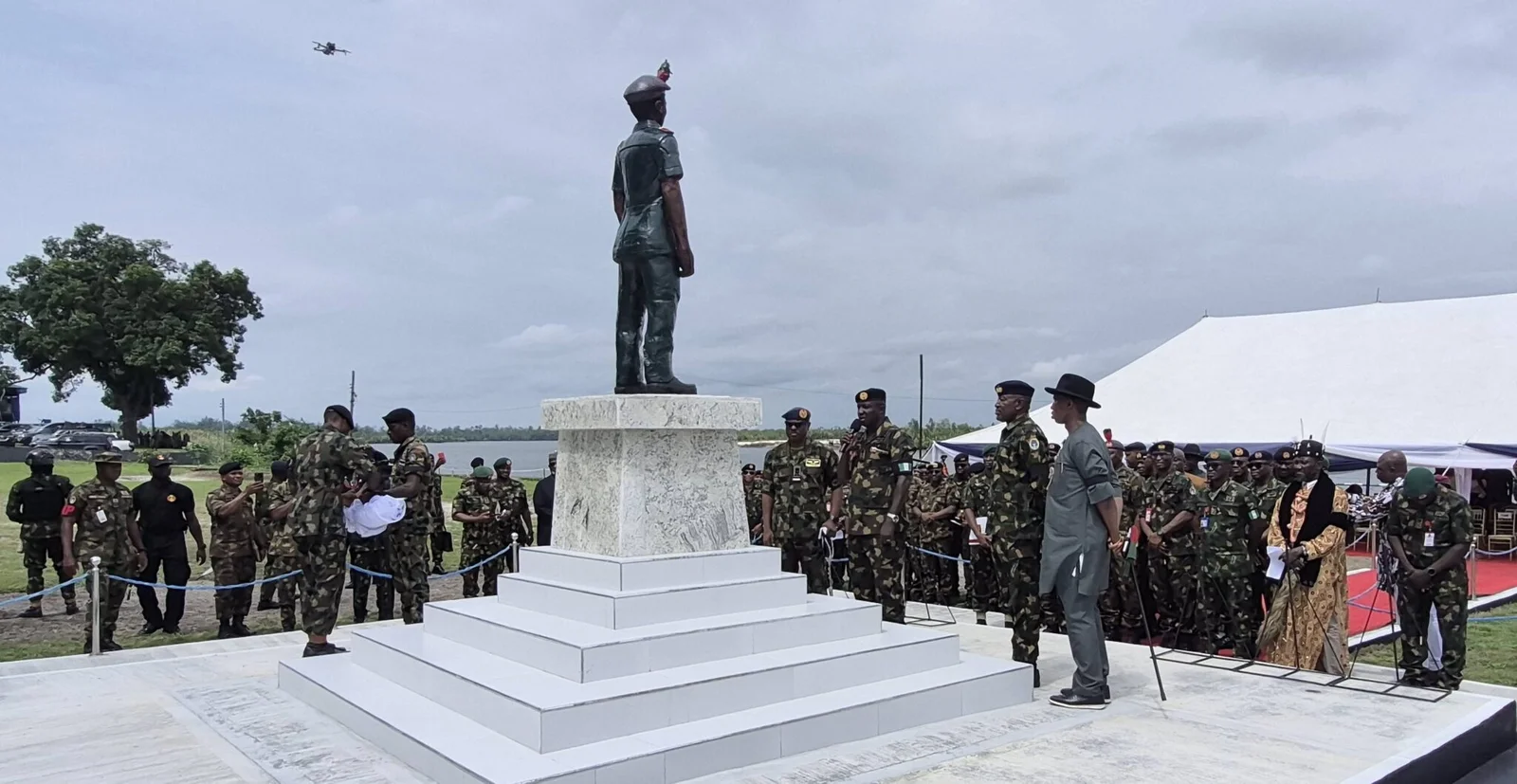
The Chief of Army Staff (COAS), Lt.-Gen. Waidi Shaibu, unveiled a cenotaph in honour of the cadets during a solemn wreath-laying ceremony at the Nigerian Navy Basic Training School (NNBTS), Onne, Rivers State, bringing closure to one of the Nigerian military’s most painful training tragedies.
The News Agency of Nigeria (NAN) reports that the fallen cadets belonged to the 41 Regular Course of the NDA—the same course attended by Shaibu.
The 11 cadets lost their lives on July 23, 1990, during a boat handling exercise at the then Nigerian Naval College, Onne, after their boat collided with a stationary jetty and capsized.
Standing before the newly unveiled monument, Shaibu reflected on the significance of the occasion, describing it as more than the commissioning of a structure.
“We gather not merely to commission a monument but to consecrate a sacred place of remembrance for our beloved course mates,” he said.
For Shaibu and many of those present, the ceremony was deeply personal. The monument, he said, represents an enduring tribute to 11 young patriots whose dreams of serving Nigeria were cut short before they could wear the nation’s uniform in active service.
“On that fateful day, 11 promising officers in the making lost their lives. It remains one of the saddest chapters in the history of military training in Nigeria,” he said.
Although the cadets never made it to the battlefield, the Army chief stressed that their sacrifice was no less significant.
“Their sacrifice is no less profound, and their memory deserves to be preserved and honoured for generations to come,” he said.
He described the cenotaph as a symbol of courage, selfless service, comradeship and unwavering commitment to duty, adding that it would stand as a permanent reminder of the sacrifices made by military personnel in service to the nation.
Shaibu also extended sympathy to the families of the deceased, assuring them that the country would never forget the price their loved ones paid in preparation for national service.
The Nigerian Navy also used the occasion to reaffirm its commitment to preserving the memory of the fallen while strengthening safety measures in military training.
Chief of Naval Staff, Vice Adm. Idi Abbas, represented by the Chief of Administration at Naval Headquarters, Rear Adm. Jonathan Mamman, described the cenotaph as a long-overdue recognition of the cadets’ sacrifice and commended the Nigerian Navy Basic Training School and the Naval Training Command for making the project a reality.
According to him, the monument sends a powerful message that the fallen cadets have not been forgotten.
“Their names and devotion will forever remain part of the proud heritage of the service and an inspiration to future generations of officers, ratings and cadets,” he said.
While acknowledging that no words could erase the grief endured by the families, Abbas said the tragedy had left an enduring impact on the Navy’s approach to training.
He noted that military training, by its nature, would always involve risks, but said the 1990 accident prompted critical reforms aimed at preventing similar incidents.
“Training doctrines and standard operating procedures are being continuously reviewed to align with international best practices.
“Greater emphasis is now placed on comprehensive risk assessment, enhanced supervision, improved emergency response capability, and the use of modern training aids and simulation technology,” he said.
Abbas added that the Navy was also investing in the professional development of instructors while strengthening welfare, medical support and psychological resilience programmes for trainees.
According to him, the goal is to produce personnel who are physically fit, mentally resilient, professionally competent and ethically grounded.
As wreaths were laid beneath the newly erected cenotaph, the ceremony transformed a decades-old tragedy into a renewed promise that the sacrifice of the 11 young cadets would remain part of the Nigerian military’s collective memory—an enduring reminder that even those whose service ended before it truly began are never forgotten.
